Showing posts with label books. Show all posts

Friday, January 6, 2012

The Thread: Blood Work by Holly Tucker

This will be the thread I continue to post on while reading Blood Work: A Tale of Medicine and Murder in the Scientific Revolution by Holly Tucker. If any reader feels so inclined, you may of course post your thoughts about the book in the comments section below.

I'm about 135 pages in and absolutely loving this. It's nonfiction, of course, about the first blood transfusions in the 17th century. What starts as dog-to-dog transfusions (usually from a larger canine to a smaller) quickly progresses - as both English and French transfusionists compete - into transfusing blood from one animal species to another (horse-to-goat, for instance) and, eventually, the first ever animal-to-human blood transfusions. At the center of these experiments is Jean-Baptiste Denis, a Frenchman rising to popularity who, after a botched transfusion kills a man, is accused of murder.

But Blood Work is more than blood. It is also an account of how we got to those first transfusions, the steps and missteps, and how blood transfusions were banned for two hundred years thereafter. The chapter on the Great Plague of London in 1665-6 and of the London Fire were particularly horrifying and captivating.

In part, Blood Work is fascinating because Tucker's prose doesn't read like a stuffy historical narrative; instead, I am reminded of magical realists like Gabriel Garcia Marquez. She doesn't shy away from writing grotesquely vivid descriptions of the transfusions and, accompanied by the illustrations of the experiment tables and tools used, Blood Work may not be for the faint of heart. There is much cruelty in scientific discovery.

But so far it is a fascinating exploration of a dark and somewhat obscure moment in the history of science, and one I hope you'll continue to read with me.

UPDATE 01/14/2012

Blood Work was mesmerizing; Tucker made the 17th century come alive through her extensive research and her sparse, but elegant prose. Indeed, she was even able to correlate those early transfusions with the ongoing debates concerning hESC today. Imagine if, as Tucker posits, transfusionists had been allowed to continue their work even after the Denis debacle: how many more people might we have saved throughout history and, given the possibility of even greater benefits through hESC research, how many more could we save in the future?

Saturday, December 24, 2011

Reading: Won't You Join Me?

Below, I've posted the books I'll be reading in the first three months of the new year. I think it would be wonderful of any of you dear readers would like to join me in reading these books. After the two week reading period (or thereabouts) for each book indicated below, I'll post a short blog on my thoughts about the content and you can post yours in the comments section if you so choose. (Note: none of these books is slated for publication in 2012; they've all already been published and most are either available in paperback or on the kindle and other ereaders.) So. Are you ready for this? Okay then.


01/01/12 through 01/14/12 Blood Work: A Tale of Medicine and Murder in the Scientific Revolution by Holly Tucker

01/15/12 through 01/28/12 Your Face Tomorrow: Fever and Spear by Javiar Marias

01/29/12 through 02/04/12 Germline by T.C. McCarthy

02/05/12 through 02/18/12 After the Apocalypse by Maureen F. McHugh

02/19/12 through 02/25/12 Spaceman Blues by Brian Francis Slattery

02/26/12 through 03/03/12 The Mezzanine by Nicholson Baker

03/04/12 through 03/17/12 Alliance Space (including the novels Merchanter's Luck and Forty Thousand in Gehenna) by C.J. Cherryh

03/18/12 through 03/31/12 Up Against It by M.J. Locke

Take the plunge with me, won't you? And happy holidays!

Thursday, October 27, 2011

Best First Opening Lines of the Year (With Conditions)

I thought I'd do something fun in gearing up for National Novel Writing Month (NaNoWriMo) as well as the requisite "Best Of" lists that will populate this here bloggy-blog for the rest of the year, mostly. And that fun thing? Oh, you know, the 10 best first opening lines from novels or stories I've read this year - which means, of course, not all of these are from books or stories published in 2011, though most of them are. Are we having fun yet? Okay, great. Here goes:

10. "Interviewer: Can you introduce yourselves?
      "Alpha: We are third-generation intelligent agents of LogiComm Works, Inc., designed to calculate and settle agreements for our clients.
      "Beta: We are designed to filter out emotional noise factors that may prevent human agents from coming to an equitable resolution that maximizes efficiencies." - "Saving Face" by Shelly Li and Ken Liu (from Crossed Genres, January 2011)

9. "The tent is draped with strings of bare bulbs, with bits of mirror tied here and there to make it sparkle. (It doesn't look shabby until you've already paid.)" - Mechanique: A Tale of the Circus Tresaulti by Genevieve Valentine

8. "We sat on a hill. We watched the flames inside the balloons heat the fabric to neon colors. The children played Prediction." - Light Boxes by Shane Jones

7. "It began, in a way, with the midget hunchback tuk-tuk driver." - "Aphrodisia" by Lavie Tidhar (from Strange Horizons, August 2010)

6. "I'd never wanted to go to Earth until the doctor told me I couldn't, that my bones were too brittle." - "Long Enough and Just So Long" by Cat Rambo (from Lightspeed Magazine, Feb 2011)

5. "It is possible I already had some presentiment of my future." - The Shadow of the Torturer by Gene Wolfe

4. "For years the air above the earth had begun sagging, suffused by a nameless, ageless eye of light." - There is No Year by Blake Butler

3. "In some places, time is a weak and occasional phenomenon. Unless someone claims time to pass, it might not, or does so only partly; events curl in on themselves to form spirals and circles." - "The Aunts" by Karin Tidbeck (from ODD? Anthology, October 2011)

2. "There is no book about me. Well, not yet. No matter." - "The Book of Phoenix: Excerpted from The Great Book" by Nnedi Okorafor (from Clarkesworld Magazine, March 2011)

1. "Morning light the sulphur color of the mine dumps seeps across Johannesburg's skyline and sears through my window. My own personal bat signal. Or a reminder that I really need to get curtains." - Zoo City by Lauren Beukes

Tuesday, August 30, 2011

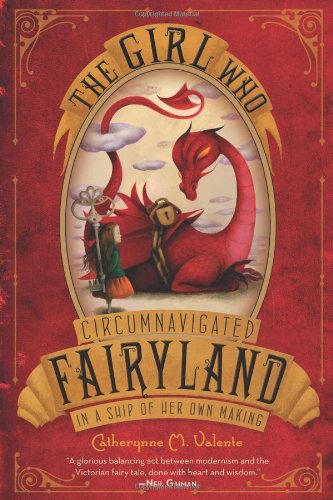
Reading: The Girl Who Circumnavigated Fairyland in a Ship of Her Own Making by Catherynne M. Valente

I was reminded, to a certain degree, of the works of Angela Carter in Catherynne M. Valente's lovely The Girl Who Circumnavigated Fairyland in a Ship of Her Own Making. This might well be a YA kind of story but, as with most of Valente's work that I've read - and like Angela Carter - there are sufficient heapings of gloom and doom (uhh...not that YA can't have that or something; remember M.T. Anderson's Prince of Nothing duology or Sue Towsend's hilarious but ultimately heartbreaking The Secrety Diary of Adrian Mole, to name a couple?). So I guess what I'm saying, in a very roundabout way, is: The Girl Who Circumnavigated Fairyland in a Ship of Her Own Making rocks.

September, our heroine, is transported to Fairyland upon by the Green Wind - who has taken pity on her. Once in Fairyland and after having chosen the cruelest of three paths, Setpember sets out on a quest to return a spoon stolen by the Marquess - the current ruler of Fairyland - from the witches Hello and Goodbye, and their wairwulf husband Manythanks. The journey becomes much more than a spoon's quest, however, as September learns that something is terribly amiss in Fairyland and it seems the Marquess is to blame. Along her way September gains companions A Through L - a wyvern fathered from a library - and Saturday - a sea creature called a Marid who eats stone. The journey for the spoon - and then later for a sword - will take them across Fairyland, though it isn't like any Fairyland you've seen before: this Fairyland is dangerous and, afraid of angering the Marquess, many will do her bidding, making it hard to know who to trust. By the end, even September is not the innocent, young girl she was when the Green Wind whisked her off from her parents' house. Highly Recommended.

Here is an excerpt of The Girl Who Circumnavigated Fairyland in a Ship of Her Own Making:

In Omaha, signposts are bright green with white writing, or occasionally white with black writing. September understood those signs and all the things they pointed to. But the signpost before her now was made of pale wind-bleached wood and towered above her: a beautiful carved woman with flowers in her hair, a long goat's tail winding around her legs, and a solemn expression on her sea-worn face. The deep gold light of the Fairyland sun played on her carefully whittled hair. She had wide, flaring wings, like September's swimming trophy. The wooden woman had four arms, each outstretched in a different direction, pointing with authority. On the inside of her easterly arm, pointing backward in the direction September had come, someone had carved in deep, elegant letters:

                              TO LOSE YOUR WAY

On the northerly arm, pointing up to the tops of the cliffs, it said:

                              TO LOSE YOUR LIFE

On the southerly arm, pointing out to sea, it said:

                              TO LOSE YOUR MIND

And on the westerly arm, pointing up to a little headland and a dwindling of the golden beach, it said:

                              TO LOSE YOUR HEART

Monday, August 29, 2011

Reading: Mechanique: A Tale of the Circus Tresaulti by Genevieve Valentine

Mechanique: A Tale of the Circus Tresaulti, the debut novel by Genevieve Valentine, is the best book I've read so far this year. The language of the novel is poetic and hypnotic and moving. It's a short novel, but Valentine managaes to get across so much with so little - a gift if ever there was one, truly.

It's about a traveling circus in either an alternate Earth or a post-apocalyptic Earth. The circus is run by the enigmatic Boss, a woman with an ambiguous past and strange magical powers. In this circus, many of the performers are kept alive by adding mechanical components to their bodies - from Panadrome, the one-man orchestra, to Elena the aerialist with brass bones. Even as the circus is hounded by "government men," there is a quiet war between several performers and a pair of gold wings Boss keeps.

You might be saying to yourself, isn't the whole circus thing kind of worn thin? Perhaps so, but Valentine injects it with grace (sidenote: now I'm imagining a needle full of grace in my arm) and heartbreak. Even though it is a somwhat nonlinearly structured novel, every scene works toward its inevitable conclusion with surprising wonder. Supremely-doo-remely Recommended.

Here is a an excerpt from Mechanique: A Tale of the Circus Tresaulti:

Little George was slated to be fixed, but Boss keeps him out of the workshop even after he asks, and so he keeps moving slowly through time until he's older than Ying, until he's nearly as old as Jonah, who has been twenty-five since the day he came to the circus and was gifted with his clockwork lungs.

Slowly, Little George begins to wake up to the world in a way he cannont name.

He does not know that Ying will never be older; he does not know why he takes such care not to anger the Grimaldi brothers. He is not aware, only awake.

He knows nothing for certain; he only sees that when the government man is gone, the circus gathers in two groups to see what Boss will do: who are alive, and those who have survived the bones.

Thursday, August 25, 2011

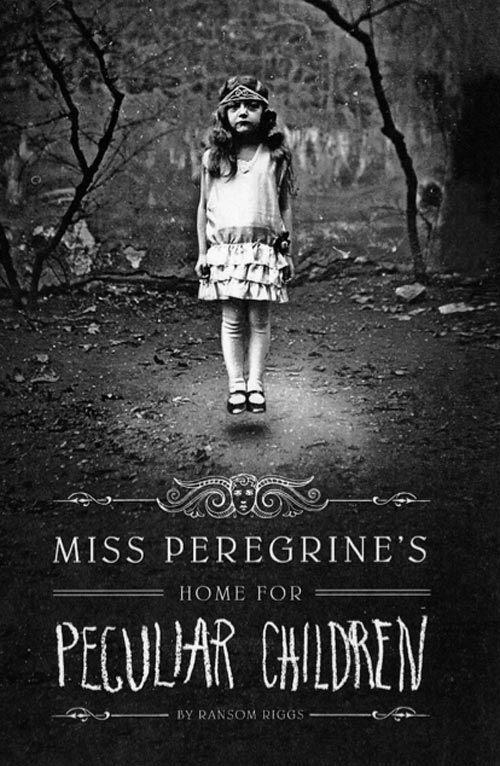
Reading: Miss Peregrine's Home for Peculiar Children by Ransom Riggs

What initially piqued my interest in Miss Peregrine's Home for Peculiar Children by Ransom Riggs was the use of "found photographs" within the text. Most of the photographs are from the archives of Robert Jackson and, make no mistake, there are some truly peculiar, even haunting, photos here. However, I found the conceit wearisome after about 100 pages with each photo being introduced by a sudden "remembrance" from the narrator - surely, there are more ways to incorporate the photos than merely "I remember..."? The twists near the end of the story I also thought were predictable and not all that interesting, making it fairly easy to see how the story will continue - this book being the first in a series. That doesn't mean Riggs won't surprise (though I can't imagine the second book using found photos again as its hook), and I'm invested enough in the characters I'll give the next book a fair shot.

In this story, young Jacob's grandfather tells him stories of a strange past - fighting monsters and living in a boardinghouse on an island off the coast of the UK with other "peculiar" children, all of whom had some sort of strange power, whether it be invisibility or amazing strength or weightlessness - but Jacob's father convinces him that his grandfather's stories are just stories, despite the photographs to the contrary, and that his grandfather had been escaping Nazi Germany during WWII. But Jacob's life is turned upside down when his grandfather suddenly dies and clues point toward the truth of his mysterious past as a "peculiar" child. On the advice of his therapist, Jacob visits the island where the boardinghouse resides, and meets some very strange folk there.

Here is an excerpt from Miss Peregrine's Home for Peculiar Children:

I recognized them somehow, though I didn't know where from. They seemed like faces from a half-remembered dream. Where I had seen them before - and how did they know my grandfather's name?

Then it clicked. Their clothes, strange even for Wales. Their pale unsmiling faces. The pictures strewn before me, staring up at me just as the children stared down. Suddenly I understood.

I'd seen them in the photographs.

The girl who'd spoken stood up to get a better look at me. In her hands she held a flickering light, which wasn't a lantern or a candle but seemed to be a ball of raw flame, attended by nothing more than her bare skin. I'd seen her picture not five minutes earlier, and in it she looked much the same as she did now, even cradling the same strange light between her hands.

I'm Jacob, I wanted to say. I've been looking for you. But my jaw had come unhinged, and all I could was stare.

Tuesday, August 23, 2011

Reading: Emma Bull's Territory

Just finished reading Territory by Emma Bull. And: Wow. Must. Read. Everything. Bull. Has. Written.

 Territory, anyway, is a western story, set in Tombstone, AZ, in 1881, a few months before the famous shootout at the OK Corral - with one huge difference: in Bull's Old West, there are supernatural forces at work. It's a wonderful alternate history leading up to the events of the famous aforementioned gun fight. But if you're expecting the stereotypical western story (read: big shootouts, mysterious strangers, marauding Apaches), you will be disappointed or, in my case, pleasantly surprised (some of these things are there, but in very unexpected ways). While reading the book I was reminded of the awesome short-lived and much-loved HBO series Deadwood with its mixture of real people and fictional characters, although no one in Territory said "fuck" as much (heh). Bull's absolutely intoxicating prose made the world and the characters come to life - every sense was satisfied. Supremely Recommended.

Here is a short excerpt from Territory, during which one of the characters, Jesse, is taming Virgil Earp's horse:

Spark came down again, and to his knees; reared again, staggered back on his hind legs. Jesse stayed with him. Sweat blackened the hair on the colt's neck and flanks and legs. Jesse talked to him, his voice gentle, while he kept the strap tight in his right hand.

He hated this part. He hated the fear the horse felt, the way that fear grew as the animal learned that nothing it did could win this fight. If he'd handraised Spark as he had Sam, this wouldn't be necessary. But Sam had been made to believe since before he'd first stood up that Jesse was stronger than he was. Spark still had to be convinced. The more of his strength he used, the more of it there was for Jesse to turn against him.

Humans expected horses to think like humans. Jesse knew better - but it troubled him that, in a horse, wisdom could grow out of fear.

Thursday, August 18, 2011

Hugo Nominees: My Picks

Sadly, I won't be attending Renovation (Worldcon in Reno, NV, the king con of cons) this weekend so I will be unable to vote for the Hugo Awards - one of SF's most prestigious awards. Regardless, I intend to give you my picks in the categories where I'm familiar with the works or individuals nominated. You can find a full list of nominees here. I'll be attending next year's Worldcon in Chicago and I invite all of you to join in on the fun (and to read these books and magazines).

BEST NOVEL
The Hundred Thousand Kingdoms by N.K. Jemisin. The award will probably go to Connie Willis for Blackout/All Clear, but I'd choose Kingdoms any day over these two. I also find it kind of unfair that Willis has two books nominated as one; Jemisin's second book in her Inheritance Trilogy too and that book, The Broken Kingdoms, is also wonderful.

BEST NOVELLA
"The Lady Who Plucked Red Flowers beneath the Queen's Window" by Rachel Swirsky. Ted Chiang is a worthy adversary, but I believe Swirsky will take this one home. One of the best stories I've read in several years.

BEST NOVELLETE
"The Jaguar House, in Shadow" by Aliette de Bodard. This is a tough category. I really like James Patrick Kelly's "Plus or Minus," and Allen M. Steele's "The Emperor of Mars." Honestly, it's almost a toss-up between these three, but de Bodard's stands out a little more above the crowd.

BEST SHORT STORY
"The Things" by Peter Watts. Despite this story being based off John Carpenter's The Thing, it is amazing. Alas, it is also very tough to choose in this category. Both Kij Johnson's "Ponies," and Mary Robinette Kowal's "For Want of a Nail" are fantastic too.

BEST DRAMATIC PRESENTATION, LONG FORM
Inception, directed by Christopher Nolan. Despite its somewhat flawed conceit, this movie could've been a full-blown disaster and it wasn't. In fact, it was quite engaging. (Sidenote: I almost went with Scott Pilgrim vs. the World, but Scott didn't end up with Knives which was, to me, as infuriating as Duckie not ending up with Andie in Pretty in Pink. Come on, Knives is so cool!)

BEST EDITOR, SHORT FORM
John Joseph Adams. Lightspeed and Fantasy Magazines publish some of the best SF out there today.

BEST EDITOR, LONG FORM
Liz Gorinsky. I love Tor Books and Gorinsky is doing some amazing work there.

BEST SEMIPROZINE
Lightspeed Magazine. For the reasons stated in the Best Editor, Short Form section.

JOHN W. CAMPBELL AWARD FOR BEST NEW WRITER (not a Hugo)
Lauren Beukes. One helluva writer. I'm curious as to why Zoo City wasn't nominated for best novel.

Apologies to the best fanzines and fan writers and graphic stories, et cetera, but if I didn't pick from your category it's because I'm not familiar with the nominees. Hopefully, by next year, I will have rectified this ignorance. In the meantime, good luck to all the nominees!

Thursday, August 4, 2011

Not-Remotely-A-Review (Spoiler): A Dance With Dragons by George RR Martin

Beware, Dear Reader: This is NOT a review of A Dance With Dragons. These are my thoughts after having just finished reading it. Spoilers most definitely follow. Take heed.


I've finished A Dance With Dragons, the fifth book of George R.R. Martin's A Song of Ice and Fire series and, as expected, I was engrossed, entertained, surprised, befuddled, and, perhaps most importantly, transported once again into Westeros and across the Narrow Sea. I tasted the dishes of the many feasts in Mereen; I smelled the piss and sweat of Old Volantis; I shivered in the snows outside Winterfell and along the Wall; my teeth chipped; my flesh was burned from dragon fire.

Yeah. I pretty much loved it.

Each book in the series opens with a viewpoint from a minor character who inevitably meets his death by prologue's end, but ADWD's prologue has stuck with me - I was fortunate to hear Martin read it at Mysterious Galaxy in San Diego during Clarion - and, even now, after finally reading it in print, I still think it to be the best prologue he's written in the series thus far. The viewpoint is from Varamyr Sixskins - a skinchanger, a warg, a wildling. He is dark and sadistic and vengeful and must confront his own mortality and the dangers and madness skinchanging brings. The prologue is made all the more relevant as several of my favorite characters - Jon Snow, Arya Stark, and especially Bran Stark (all of which have viewpoints in the book) - have the potential to become skinchangers and face the same dangers as Varamyr.

Along with the aforementioned viewpoints, a lot of fans were also happy to see the return of Danaerys Targaryen and Tyrion Lannister. I was too, though to be fair, I didn't miss them all that much in the previous volume, A Feast for Crows. Without going off on a tangent and detailing the history of the previous books, let me just say that in the third volume a lot happened and some characters went off to do other things and, Martin realized writing the fourth volume, to encompass all of the storylines into one book would make for a tome the size of which would be encyclopedic; intsead, he cut the books in half - not by character arc, but by geography, so as to tell most of some of the character's stories in the fourth book and the rest in the fifth. Dance is the second half of that split (although the final third of the book moves past the events in Feast). Many readers were frustrated by the numerous minor character viewpoints that filled the brunt of the fourth volume; I, however, was fascinated by these characters - particularly the ironborn and the Dornishmen - and find AFFC to be an underrated affair.

It was quite enjoyable to catch up with Tyrion and Bran and Jon Snow and Dany, to be sure, but again I found myself rooting for and, just as much, against the various minor viewpoint characters in Dance. I have grown quite fond of Asha Greyjoy and still despise her brother, Theon, no matter how much sympathy Martin writes him with. Melisandre remains a mystery to me; I want to believe she is good, but even having read from her point-of-view, I'm still as confused as to her allegiance as I was before. Other viewpoint characters - Quentyn Martell and Ser Barristan Selmy, for instance - served to move the plot along in Mereen after Dany's disappearance and I suspect helped in untangling the "Mereenese knot" Martin had been stressing over.

Yet, perhaps the most surprisng and head-scratching part of Dance was the appearance of once-thought-dead Aegon Targaryen. According to Westerosi history, Aegeon - still a babe - was killed along with his sister and parents in the sack of King's Landing. In Dance, however, we learn that another child - a peasant babe - replaced Aegon and Aegon himself escaped in the care of Lord Jon Connington, former Hand of the King, and with the help of Varys, and has grown up across the Narrow Sea, taught about the Seven and other various Westerosi customs. Obviously, with Dany also vying for the Iron Throne (and taking her time about it, too, learning to rule in far away Mereen), Aegon complicates things heavily.

Already interwebbers are speculating that Aegon is a fake, a pretender to the thrown - a "mummer's dragon" - and that this is but a distraction, and though I too have my doubts as to Aegon's bloodline, I do wonder. To me, it doesn't seem very GeoRRge-like to throw up a fraudulant Targaryen at the last moment because it feels kind of "plot-y" and, if anything, "plot" in its typical sense is not central to A Song of Ice and Fire. Yet, Varys tells Ser Kevan Lannister in the epilogue that Aegon's arrival in Westeros couldn't be more perfectly timed - the unrest in the Seven Kingdoms was settling down and this is the very thing that will keep it alive - a Targaryen in the flesh, come to retake the Throne. As far as I'm concerned, however, the Aegon has Targaryan blood and that this one of Varys's plots - to have both Aegon and Dany take the Iron Throne. Targaryens did wed sister and brother, after all, and though a marriage between Dany and Aegon would be niece to nephew, they are near the same age. I'm probably wrong.

Many fans are also speculating on the fate of Jon Snow, Lord Commander of the Night's Watch. In his final chapter he was betrayed by his own men and stabbed, presumably, to death with daggers. There is talk that Jon Snow is actually Azhor Azhai returned and not Stannis Baratheon, but I wonder about this too.

First of all, I think it likely Martin has killed off yet another main character. I don't want to believe that, but so many good people have died in this series, it's hard not to. If Snow is really dead, this also creates chaos at the Wall - just when order is needed most. Jon was, of course, settling the Gift with wildlings and manning many of the vacant castles along the Wall with them too to fight against the coming battle with the Others. With his death, the black brothers will fall into disorder and infighting. This will undoubtedly make it harder for Dany, once she arrives in Westeros with her dragons, to fight the Others.

Secondly, however, Jon Snow's death fits Martin's MO: that is, honor alone will not save you; you know, nobody likes do-gooders. The interwebbers have a good point though: there is still the mystery of Jon's mother and, though some if it was discussed in Dance, it's still as much a mystery as ever; and that Melisandre may bring him back through a sacrifice to the Lord of Light. There are also similarities between the end of Jon Snow's chapter and Arya's chapter in A Storm of Swords wherein "the axe took her in the back of head." No matter how it pans out, I was stunned when I read Jon Snow's final chapter, much how I felt when I read the Red Wedding in A Storm of Swords. I looked up and said, "No. No. No. What. No."

It seems, too, that Dany is finally going to make her way to Westeros. After having disappeared from Mereen riding her dragon Drogon, Dany, lost and hallucinating in the desert, comes across a khalasar led by Khal Jhago. Again, I can't say what will happen with this scenario with any certainty, but it seems as though Dany will lead this khalasar to Mereen, crush the Yunkai'i, and set forth for Westeros. Martin is a master at defying expectations, however, so we shall see. Regardless of where she goes, I found Dany's chapters to be some of the best in the book. She learns as much from her mistakes as her successes and though she confesses many times to her council that she is "but a young girl," she is far from it, the sarcasm of those words nearly spitting from her mouth. There is a part of me, however, that no longer even cares if she invades Westeros - to me, the story has always been more about the characters than any sort of over-arching end-of-the-world plot. I don't really care about the big fight between good and evil; I care about the little everyday fights within ourselves.

Which brings me to my concluding points about A Dance With Dragons. There has been some frustration from readers that "nothing happens" in this book. Well...they're right and they're wrong. If you want a big sea battle or a fight with the Others and Cersei to set King's Landing on fire, you'll be disappointed. Those things don't happen. What does happen, though, is all around character growth. Cersei is humiliated, Arya must put aside her past, Bran learns what he is and what he can be, and so on. The characters move through the world and the world is made richer. Not everything in this book advances the plot and, in some cases, even seems to stall it. As George himself said though, "My philosophy is that plot advancement is not what the experience of reading fiction is about. If all we care about is advancing the plot, why read novels? We can just read Cliff Notes."

Wednesday, May 4, 2011

A List of My Favorite Books (So Far) in 2011

With awards season right around the corner - we've got Locus, Nebula, Hugo, Jackson, to name a few  - I thought I would go ahead and list some of the books I've liked reading the most in 2011. They're weren't all published this year or even last year and I don't think any of them are nominees for any of the awards listed above except Nora Jemisin's first book, The Hundred Thousand Kingdoms. Regardless, these are books I'll probably read again and again.

Redemption in Indigo by Karen Lord (Small Beer Press)

The Fixed Stars: Thirty-Seven Emblems for the Perilous Season by Brian Conn (Fiction Collective)

The Hundred Thousand Kingdoms/The Broken Kingdoms by NK Jemisin (Orbit)

Babel 17/Empire Star by Samuel R. Delany (Vintage)

Light Boxes by Shane Jones (Penguin)

Leviathan Wakes by James S.A. Corey (Orbit)

Half World by Hiromi Goto (Viking)


Most of the aforementioned books I've reviewed on this here blog, but a few, like Shane Jones's Light Boxes, I haven't had time to yet; others, like Leviathan Wakes, will have a review within the next week or so. I'm currently reading Catherynne M. Valente's Deathless and really loving it.

Though I have quite a backlog of books to get through, I've recently picked up the following and I can't wait to read them:

Mechanique: A Tale of the Circus Tresaulti by Genevieve Valentine (Prime)

The Quantum Thief by Hannu Rajaniemi (Tor)

Embassytown by China Mieville (Del Rey)

Up Against It by MJ Locke (Tor)

A Dance With Dragons by George RR Martin (Bantam)


Do YOU have any favorites?

Wednesday, March 16, 2011

Review: The Ouroboros Wave by Jyouji Hayashi

The Ouroboros Wave by Jyouji Hayashi is one of those "hard sf" novels packed with ideas. Technically speaking (that's not really a pun, but it kind of is), Ouroboros is not a novel: it's a series of interlinked short stories detailing humankind's accidental stumble into the stars; though every discovery pushes us closer to an understanding of our place in the universe. Indeed, Hayashi's motif throughout is "happensance is necessity in disguise."

The first of these interlinked stories concerns a black hole discovered by, you guessed it, happenstance. What's particularly interesting about the black hole, dubbed Kali - the Hindu goddess of destruction - is that it's on a collision course with the sun, our sun. Unfortunately, scientists are unable to determine if that collision will be in a few hundred years or in a few thousand. Rather than wasting time debating, an artificial accretion disk is built around Kali to not only change its course toward Uranus, but also, once in orbit around the gas giant, to harness the black hole's "boundless energy." However, in these early development stages, an AI nicknamed Shiva begins exhibting signs of awareness outside of cyberspace - that is, human-like intelligence - and endangering the scientists living on the artificial accretion disk.

In fact, what Hayashi is most concerned with throughout these stories besides proving that happenstance is masked necessity is determining what is and is not intelligent. In another of the stories, a submarine is encapsulated in the mouth of a giant jellyfish-like creature in the icy oceans beneath the surface of Europa; this creature may or may not be the first signs of intelligent life outside of Earth. In another, an assassin must out-think a complex system of identification modules to make her target. Is Hayashi also asking the question: is intelligence formed from happenstance?

We haven't even discussed the surplus of cool sf ideas rampant throughout Ouroboros. For instance: Amphisbaena, the needle-like station in orbit around the artificial accretion disk that houses the scientists; the web system of data transfer; the AI Salmon; the different political structures between Earthborn and Spaceborn peoples; etc.

If there is one detriment to Hayashi's Wave, it's the prose. The prose is so dry at times it's like reading sandpaper. I don't know if Hayashi's voice is this dry in the original Japanese or if something was lost in Jim Hubbert's translation; either way, it can make for tedious reading. There is also a lot of "telling, not showing," in the text, which is one of my pet peeves. The redeeming quality (other than the wealth of ideas and an interesting backstory) is that because Ouroboros is hard sf - I mean, extreme hard sf - the reader can get easily lost in those large, scientific words, but Hayashi is a master of making big concepts (like exactly how an artificial accretion disk might harness the energy of a black hole) easily understood.

The Ouroboros Wave is worth the read; however, if you're not a deep lover of hard sf (and, typically, I am not) you're going to have to get through some pretty serious slog to enjoy the story.

Thursday, March 10, 2011

Fast Tomes at Ridgemont High: Rediscovering Heroic Fantasy

Pardon the terrible pun of a title, but if you'll recall a few weeks ago I mentioned that my reading list in 2011 was shaping up to be (in more ways than one) the year of the great tome of books. Well, it's still true, though I haven't exactly kept pace. In February I read four books, all of them quite thin-spined but no less great because of it. The Fixed Stars by Brian Conn and Redemption in Indigo by Karen Lord are two masterpieces of fiction. Anyway, it seems as though this year, along with tomes, is also going to be the year I rediscover heroic fantasy.

Last night I attended the book signing of Patrick Rothfuss, heir apparent to the Tolkein throne. Or so many of his fans and Onion A.V. Club think him. Well, he's supposed to be really good and over the rest of March and April I will find out. Seeing Rothfuss speak at the Oak Brook Borders was certainly a treat. He read the very short prologue to his latest release, Wise Man's Fear, as well as a poem about spring he'd written and a hilariously sadistic story about guinea pigs that was published in a weekly advice column he did for his college newspaper. The Q&A section of the night was the most interesting for me, however. Several questions concerning the language of the different peoples in his books were brought up. Though Rothfuss confessed he was not a linguist as Tolkein was, there were certain facets of the languages he'd made up, mentioning that he'd spoken pronunciations of certain words into a phone for the audiobook reader to have some grounding. But Rothfuss was more interested in the psychology and sociology of peoples rather than specific patterns of language - in other words, he cares more about how a person or a people react to given situations. In other other words, I am very excited to read his books.

George R.R. Martin, an instructor of mine at Clarion, announced on his website last week that his fifth book, A Dance With Dragons, now has a release date: July 12, 2012. For thos of us that've been waiting for five years, this is awesome news. I cut my teeth on GRRM in high school and throughout the aughts. I've read A Song of Ice and Fire - the series of which ADWD is part of - probably four times now, and each time I see something new within the text. These are big books and George has promised to his latest will be just as big, so...oh boy.

Daniel Abraham is beginning a new series in April called The Dagger & the Coin. I am a huge fan of his previous fantasy outing, The Long Price Quartet, and am looking forward to the new series. However, I read the prologue of the first book, The Dragon's Path, and wasn't as impressed. Though I've heard a lot of people turned away from GRRM's books because of the prologue of his first. Sometimes prologues are slogs and maybe we should all just agree that Elmore Leonard, in his 10 rules of writing, is right: Avoid prologues.

N.K. Jemisin is also in my queue to read. She's two books deep into The Inheritance Trilogy and managed to put out both of those books within the same year. I don't know that that was a particularly well-employed marketing campaign by her publisher, but whatever: two books! I have the first one and the second one is waiting on the shelf at Borders just for me. I've heard all kinds of excellent things about Jemisin and her work, so I'm excited to read these books. These aren't tomes, however: around 330 pages with crime novel-sized print. (That's not a jab at crime novels, I swear. I love Elmore Leonard. Also, second Leonard reference? Check.) I've had Jemisin's first book, The Hundred Thousand Kingdoms, for awhile now and there really isn't a reason I haven't read it yet.

Except this:

I've called this post "Rediscovering Heroic Fantasy" for a reason. The last heroic fantasy book I read was in 2006 and it was A Feast for Crows by George R.R. Martin. Yep, the book prior to the July 12 release. It's not that I haven't tried. I really really really tried to like Steve Erickson's Mazalan Empire, but ugh, no thanks. I loved the aforementioned Long Price Quartet, though I don't count them as heroic fantasy; if anything Abraham's series is tragic fantasy. Anything published by Pyr Books I tend to stay away from. Joe Abercrombie has enticed me before - but especially since he was mentioned in the recent diatribe of the doom of fantasy from Leo Grin (note: a lot of fantasy writers responded to Grin's scathing essay and I'm definitely in their camp: I like my heroes tragically flawed, thank you very much.) Another is R. Scott Bakker: I read the first two books in his Prince of Nothing trilogy, but sort of lost enthusiasm to read the third. I liked them, but I didn't love them - or maybe it wasn't the right time for me to read them.

That said, I'd definitely like to give Abercrombie and Bakker a shot. Perhaps later this year I will. Right now, however, I've got so much on my plate. The books mentioned above, and Shantaram awaits me, as well as the Javier Marias series, the new Jesse Bullington and Genevieve Valentine, Gene Wolfe, dear lord, it won't stop.

Are they any other heroic fantasy books I should have read/be reading?

Friday, February 25, 2011

Review: The Fixed Stars: Thirty-Seven Emblems for the Perilous Season by Brian Conn

Like Grace Krilanovich's The Orange Eats Creeps (one of my favorite books of 2010), Brian Conn's debut, The Fixed Stars: Thirty-seven Emblems for the Perilous Season, is a story not so much read as experienced. It is a post-post-apocalyptic world Conn's characters inhabit. The blurb on the back from Brian Evensen calls it "the future of the future" and he isn't far wrong. However, where Krilanovich was stream-of-consciousness and wildly vulgar in content, Conn's prose is quiet and full of imagery that, if not given a slow read, passes by beautifully, though that imagery, if read carefully, is also full of vulgarity and barbarism rarely written with such precision and focus in fiction.

The story is centered around John's Day, a celebration of the perverse and the barberous. A community regularly quarantines itself from plagues and copulates with each other quite vigorously. Some get lost in the woods, others get lost in a bathhouse. There are mentions of post late-capitalists. There are sections in the book that neither seem to have any purpose within its own context or, to be more particular, to forward, in any way, the plot. Many readers might see this as a flaw in the action of a novel; however, Conn has something to say you: who cares, plots come and plots go, threads are threaded and then, just as quickly, unthreaded, or prove themselves to be false threads.

What I'm getting at is that The Fixed Stars is so alien to read it is hard to grasp. The characters and the world portrayed within are so utterly unlike anything we know that, if you aren't prepared, will throw you out and it won't give a damn, not in the slightest. But if you want to experience a place that hasn't been experience before, The Fixed Stars is the place to go. I don't believe there is any way to fully understand entirely what Conn is driving at because he refuses, on any level, to give the reader anything to hold on to.

And yet. And yet, despite the lack of an empathetic character or a plot to understand, Conn imbues this world with a kind of sympathy that is also rarely seen in fiction. This world is as real and as relevant as our own. The final section is particularly heartbreaking. Though it's early in the year and this book was published in 2010, so far this is my favorite of the year.

Thursday, February 24, 2011

The Post-Bookpocalypse

Today I was a witness to a sad thing: the closing of Borders in Merrillville, IN. With the lackluster economy and the popularity of ebooks and the kindle on the rise, bookstores - even the big chains - are finding it harder to stay in business. Already I've witnessed several local, independent bookstores fall by the wayside; Barnes & Noble closed its doors a few weeks ago; and now this: Borders is closing too. The good news? There is another Borders nearby (the only bookstore besides the Christian one left in town), but how long before this one closes too?

There's a lot to say about the economic situation in the US but that's a different post. This one is more concerned with the ereading and its effect on paper books.

One of the things I've always loved about reading is not the words (though, of course, they are a rather large part of the experience - one might argue 99.9% of it, still...), but the weight of it in your hands, the smell of its pages as you flip through them, the glossy or nonglossy cover. The cover art can tell you so much about the contents inside, or it can make what awaits within its bindings more mysterious. I don't have a kindle so I cannot speak to the experience of reading from it directly but I do not believe that it can be as wonderful or as immersive as having the book - all of that paper and glue - in your hands.

Yet I know that, when the time comes (read: when I have money) I too will purchase a kindle or an ereader or some such electronic device to read books with. It isn't that I'm abased to reading electronically - hell, I love online magazines, fiction and nonfiction, and I regularly submit stories to them. There are many reasons the kindle is useful; for one, it will make those harder to find books (i.e. books not sold in most stores unless you happen to have a totally awesome indie bookstore nearby and the owner knows her shit) easier to find, assuming they are available for ereading. Whether or not these writers sell any more on the kindle than they would have in paperback depends on the marketing campaign by themselves and their publishers, but the opportunity is greater because, instead of searching through the shelves where the book is not going to be anyway or having to wait several days as the book is shipped, a reader can search through online sources and download with the click of a button. Ebooks are cheaper, too, so the potential of greater readership because of the inexpensiveness of books is higher. It's ecologically aware. And for those of us with bad eyesight, you can manipulate the font size of a book.

Still, what I am afraid of is a world wherein the paperback has become a collectible item like vinyl records. I admit it is sort of fun to walk into a record store and find something like Blue Monk Time or Silver Apple on vinyl, knowing you've found something somewhat rare but can you imagine how easily pretentious that can get? (I already feel kind of pretentious for not holding out on itunes and the ipod, for god's sake!)

Anyway, this post was supposed to be a plea to keep reading books - real books, trees be damned, prices be damned, larger font sizes be damned! Once, fans went to records store and bought Sgt. Pepper's Lonely Hearts Club Band in mono and, if you were an aficiando, in stereo and there was something magical in this experience, in taking that record home and putting it on your player and listening to it. The same goes for books: is it not exhilarating to walk into a bookstore and peruse the shelves, pick out something you might not have picked out had you not gone in, the weight of it in your hands, daring you to read it?

Monday, February 14, 2011

Review: The Sad Tale of the Brothers Grossbart by Jesse Bullington

The Sad Tale of the Brothers Grossbart, the debut novel by Jesse Bullington, is not for the faint of heart. The book follows antiprotagonists and twin brothers Hegel and Manfried Grossbart, graverobbing bastards and whoresons that they are, on their journey south from Germany to "Gyptland" for the riches of the Infidel tombs.  Along the way they battle witches and manticores, demons and sirens; the brothers believing themselves fighting on the side of the Virgin (though this line of thinking may not be wrong, exactly, twisted as it is).

It's sort of an anti-Odyssey with intermingling folktales, Nicolette's and the priest's tale as standouts. Sad Tale is written at times almost as an historical text (see the preface, specifically), but with closer points-of-view throughout so that the reader isn't too distanced from the pain and suffering and evil rampant throughout. Bullington wants you to feel this imagery and you do, you really do.

When it debuted, Sad Tale caused quite a ruckus because of its incredibly grotesque imagery and language and harsh depiction of Medieval Europe, and because it is difficult for readers to emphathize with its main characters, unless of course, you're an unsympathetic murdering bastard. Regardless, Sad Tale is a wonderfully readable and engrossing story. The Brothers Grossbard, for all their inane qualities, aren't stupid (or, rather, they're just smart enough). The bearded brothers are philosophers, debating theology with themselves and priests and laypersons throughout the novel; they are fierce fighters, unafraid of battle and death; they're crafty and remain cool under duress (for the most part); hell, they've got a sense of humor about things (I was laughing out loud as the brothers debated how many demons they killed and whether or not the pig was a demon; or Hegel's mistrusting of four-legged animals in general).

It is that playfulness, alongside the brothers' evil, that sets Bullington in a class all his own. In lesser hands, this book would've been too serious, too dark, too grotesque, too adrift without plot; but with Bullington it is all of those things and something more, something akin to perfection.

Wednesday, November 3, 2010

Top 10 Books I Read in 2010

How ya doin', kiddos?  In your "I-just-voted-now-what" revelry, I've gone ahead and made a list of the best books I've read in 2010.  Now, that isn't to say that all of these books were published in 2010, though some of the were, but these books are the ones that resonated with me the most.  A few I've read before because I reread them every year.  They're that good.  As with my Top 10 Records, there's no numbering system.  I absolutely refuse to put a number on things I like!

I wanted to give a fairly equal share of the love between non-genre and genre, fiction and nonfiction, because I read all of these; however this year I was accepted to Clarion Science Fiction & Fantasy Writers' Workshop in San Diego and I decided it was worth it to read a lot of genre work in preparation for the six-week workshop (and yes, two of the instructors are mentioned below, not because I'm trying to kiss their asses, but because their books are seriously two of the best books I've read this year; and okay, a little ass-kissing can't hurt).  The genre trend, even after the workshop, has kept up and, unfortunately, this year I've read very few nonfiction works.  I intend to change that at the beginning of the new year.

Okay.  Away we go.

Top 10 Books I Read in 2010 (not a David Letterman sketch)

The Orange Eats Creeps by Grace Krilanovich (Two Dollar Radio, 2010)
Hobo teen vampire junkie wandering the Pacific Northwest, high on meth and robitussin, and haunted by the disappearance of her sister while being chased by a serial killer.  And that's what the back of the book says.  What is this book really about?  To tell you that, I'd have to read it again and maybe a third time after that.  And I will read it again.  The first time through, however, is a stream-of-consciousness experience and the language is so vibrant, Krilanovich's sentences come to life.

The Hot Kid  by Elmore Leonard (William Morrow, Phoenix, HarperTorch, 2005)
Breezy crime noir doesn't get much better than Elmore Leonard.  This one takes place in Depression-era Oklahoma and it concerns oil and badass US Marshal, Carl Webster.  This is the kind of book you read in two days, but it's a fun and gloriously thrilling two days.

City of Saints & Madmen by Jeff Vandermeer (Tor, 2004)
Jeff happened to be one of my instructors at Clarion and I thought it was a good idea to get acquainted with my instructors through their work.  I was not let down here.  The book is four novella-length stories and then 400 pages of appendices, based on the fictional city of Ambergris.  There are more details about this city in this book than in a lot of history books about Rome - it's a good thing: Ambergris is one of the most fascinating places I've ever visited.  You've got the Festival of the King Squid, a fictional but realistic religion called Truffidianism, strange mushroom people who dwell beneath the city called gray caps, and so much more.

Nova by Samuel R. Delany (Doubleday, 1968)
Chip, as he's known in the field, was also an instructor of mine at Clarion.  I'd grown up with his divisive behemoth, Dhalgren, in my house as a kid.  I still see that deep orange sun on the cover, that first half-sentence, "to wound the autumnal city."  Say what you will about it, but I loved it.  It was, according to my father and I trust him, a testament to the fucked-upness of the sixties.  Nova is nothing like that.  Its plot is pretty typical space opera, but with Delany's singular disillusionment of  our dependence on resources and depth of character and detail.

The Windup Girl by Paolo Bacigalupi (Night Shade Books, 2009)
Bangkok, the near-future, a calorie-fueled soceity, genetic manipulation, dirigibles.  This is pretty much everything I could want in reading a novel.  We're talking violence, heartbreak, sex, love, cruelty, ignorance, empowerment.  Bacigalupi is the writer to watch, in my opinion.  Not only is this book full of ideas and warnings for our own future, but it's extremely well-written too.  Bacigalupi is creating a new kind of cyberpunk and I'm in, definitely in.

Nobody Move by Denis Johnson (Farrar, Straus, & Giroux, 2009)
This is Denis Johnson writing an Elmore Leonard novel! The only thing that could be better than this is if Quention Tarantino made a scifi movie.  Nobody Move was  an easy, swift read and excellent crime noir, definitely Johnson at his lightest.  After a heavy-hitter about the Vietnam War and intelligence or lack thereof in Tree of Smoke, I'd want to do something light too.  The rundown: dude gets caught up in some shit he shouldn't have, things get out of control, everybody wants a cut of the dough, and there's a pretty girl.  Awesome.

Middlesex by Jeffrey Eugenides (Farrar, Straus, & Giroux, 2002)
This is a book I read once every couple of years.  I love the hermaphrodite narrator, Cal/Calliope.  How s/he is able to back in time and be her grandmother and her father, witnessing the exodus from Asian Minor to Prohibition Era in the US, all of it a love story about Detroit, the ruined city.  It's heartbreaking.

Cathedral by Raymond Carver (Harvill Press, 1983)
This isn't a novel.  It's a book of short stories.  Carver writes about the regular guy purely, without any sentimentality and this is his finest collection.  I read this every year.  No other story like the first story, "Feathers," with its crazy peacock has influenced me more as a writer.  The final story, "Cathedral," is also worth the collection alone.

Who Fears Death by Nnedi Okorafor (DAW Books, 2010)
I reviewed a few weeks ago.  Okorafor's future world is a bleak desert with broken-down computers and strange sorceries.  But it's about so much more: genocide, feminism, technology, etc.  And written with such lovely style and grace.

How to Live Safely in a Science Fictional Universe by Charles Yu (Pantheon, 2010)
I reviewed this book, too, way way way back in September.  If I had to choose (and I'm not, I tells ya, I'm not!) the number one book I read in 2010, it would be Yu's masterful, How to Live... Normally, I hate time travel stories because they're usually done very poorly with gaping holes and fundamental flaws.  If Yu's novel has any of those, I've yet to see them.  He has written the perfect time travel story; and, not only that, he's written a moving piece about a son searching for his father.  Kudos, sir, kudos.  You've won me over twice.


So there they are in all their glory.  I have about 25 books on my bookshelf that I still need to read this year.  I'm currently in the middle of Ian McDonald's Brasyl and it's swimmingly good (all about the multiverse and quantum computers and the country of Brazil, wild!).  Some more books on my list:

The Thousand Autumns of Jacob de Zoet by David Mitchell
The Hundred Thousand Kingdoms by NK Jeminison
Oblivion, More or Less by Alan De Niro
The City & the City by China Mieville
Jonathan Strange & Mr. Norrell by Susanna Clarke

Anything else I should put on this list?  What are you reading?